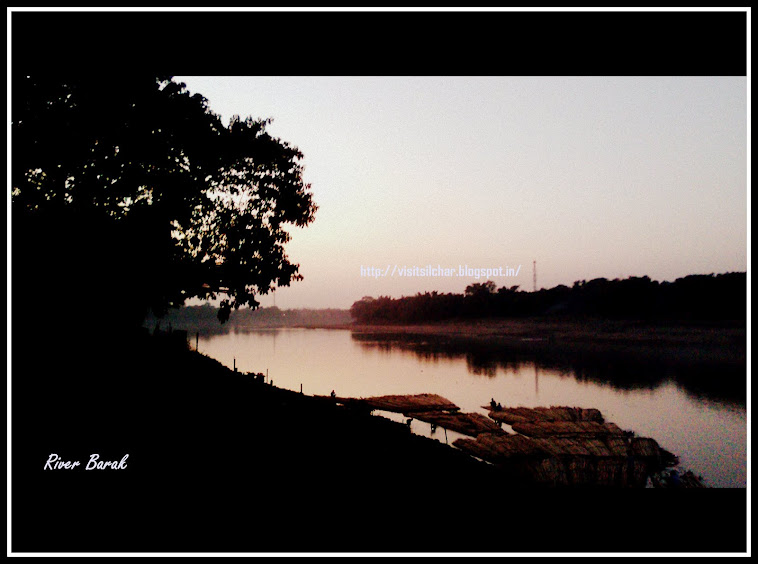
SILCHAR, Dec 26 2011: Silchar has its own historic and revolutionary
phases in its origin, growth and development from a cantonment of the
British to the present status of a populated and thriving town.
After the annexation of Cachar by the British in 1832, the English
rulers established their administrative unit at Dudhpatil, on the north
bank of river Barak. After a few years, they shifted their colony to the
villages of Silchar, Tarapur and Malugram on the south bank for
security and administrative expediency. Basically, the town was a
military base to look after the frontiers and contain the tribal rebels.
The bank of the river was strewn with stones called ‘shila’, from
which the name Silchar has been derived, pointed out Dr Manujvendra
Syam, a leading citizen of this town, while recounting all about the
history of this town.
By 1855, Silchar became a tea trading centre with plantations coming
up. It was also the time when the British railways constructed the
Silchar-Badarpur-Lumding-Dibrugarh MG rail route, connecting the port
town of Chittagong for easy communication and business.
Dr Syam said, “This town has a glorious heritage and tradition in
respect of education, freedom struggle, literature, drama,
women-liberation movement, sports and journalism”.
Boys’ Higher Secondary School, the second oldest institution in
Assam, was established in 1863. A dedicated missionary-educationist,
Miss E M Lloyed, set up the Girls’ Higher Secondary School. Both the
schools played significant role in spreading English education in this
valley. Today, we have a university and all the necessary educational
institutions, medical, engineering, science, arts, commerce, teachers’
training, polytechnic, law, fine arts as well as painting.
Dr Syam said from this town came galaxy of luminaries to shine at the
national and international arena. Kamini Kumar Chanda, first member of
Viceroy’s executive council from Assam, Dr Triguna Sen, the architect
and first rector of Jadavpur University as well as mayor of Calcutta,
Ramesh Bhattacharya, the pioneer of Bengali alphabets in telegraphic
codes, Ashok Kumar Chanda, first comptroller and auditor general of
India, Bashanti Rani Das, first science graduate with honors from
Calcutta University, Sisir Kumar Dutta, ICS, the first chief secretary
of Assam, Dr Ranjan Kumar Som, first jubilee scholar in statistics and
first Indian to be taken as chief population advisor on WHO, Dr Amaresh
Dutta, first Indian recipient of award on English poems from Rome and
chief editor of Encyclopaedia of Indian literature and languages, Dr
Nirupam Kumar Syam, first D Litt of science in Anthropology from
Calcutta University and Ashim Kumar Dutta, first Rhode’s scholar in
Assam.
This town of Silchar, Dr Syam added to say, has a revolutionary role
in the freedom struggle of the country. After the partition of Bengal in
1905, Bipin Chandra Paul, eminent orator and national leader, visited
here and gave dimension and direction to the freedom movement. Khilafat
movement got a boost with the formation of a committee in 1919 under the
presidentship of Moulana Pir Mohammed Ali.
People rose as one and extended tremendous support to non-cooperation
movement in 1921. Salt campaign of 1930 and civil disobedience movement
of 1932 gained ground under the leadership of Shyamacharan Dev. Arun
Kumar Chanda gave direction to ‘quit India movement’ of 1942 and was
imprisoned without trial. Surya Sen, Masterda, the chief of the
Chittagong armoury rebellion, came here in 1926 and formed revolutionary
organization, creating deep impact on youngsters to join the freedom
movement.
Mahatma Gandhi, Jawahar Lal Nehru and Netaji Subhash Chandra Bose
came here between 1922 and 1945 to inspire the freedom movement.
SILCHAR, Dec 27: Besides playing historic role in the freedom
struggle of this country, Silchar has also been noted for the
development of various streams of literature. The ‘man of letters’ like
Ram Kumar Nandy, Bharat Chandra Choudhury, Bhuban Mohan Bidyarnarba,
Surendra Kumar Chakraborty and other contemporaries contributed towards
literary creations. In 1925, literary magazine ‘Bhabisat’ edited by
Nagendra Chandra Syam, exponent of Rabindra Nath Tagore, initiated the
modern trend and concept in this valley and a host of writers and poets
made their appearance. Notable among them were Kamini Kumar Adhikari,
Khirod Bihari Som, Bhupendra Chandra Syam, Nirodbaran Goswami, Ashok
Bijoy Raha and others. This literary movement influenced the talents of
the time like Sudhir Sen, Ramendra Deshmukhya, Phanindra Dutta, Bijoy
Bhattacharya as well as Amaresh Dutta enriched the literature which
continues to inspire the young generations, Dr Manujvendra Syam said.
Speaking about the other significant developments, Dr Syam added to
say, Silchar has been pioneer in publishing the first woman journal
‘Bijoyani’ which was edited by Jyostna Chanda in 1940. Sarat Chandra
Chattopadhya, the great novelist, and Ramananda Chattopadhya, editor of
‘Pravashi’ and ‘Modern Review’ attended the literary conference in 1926
and 1927. Though Rabindra Nath Tagore did not visit Silchar, but the
poet got essence of this town during his sojourn through Gauhati-Sylhet
route in 1919 when he stayed at Karimganj for some time. In his most
lyrical and romantic novel ‘Sheser Kabita’, name of Silchar does come.
Dinabandhu Mitra, author of ‘Nil Darpan’ stayed in Silchar in 1871. Sir
Ronald Ross, who discovered malaria-parasite, did a part of his research
work in Labac Hospital.
The famous RDI, better known as the Reading and Dramatic Institute,
pointed out Dr Syam, was set up in 1908, the first of its kind in Assam,
which played significant role in the propagation of opera in Northeast.
Moni Bhattacharya, the maker of famous film ‘Mujhe Jine Do’, was from
this town. This town again was the centre of women liberation movement.
The first drama in Assam with absolute women casting was performed
before public 1937 under the guidance of Malati Syam, social worker and
front-liner of women liberation movement. She was also behind the
holding of sports tournament for women in 1938. Modern polo was first
played here and the polo field of this town is regarded as the oldest
one in the world. India Club, the first club in Assam, founded by Capt
NM Gupta in 1900, brought Assam on the football map of India. The
football team of this Club took part in IFA Shield in 1917 and Beighton
Cup tournament in 1920. It was again this town which brought out many
football players of eminence like Ashutosh Dutta, once captain of East
Bengal Club and others.
Recreating from the past, Dr Syam said in the field of journalism
too, role of Silchar is significant. The first newspaper titled Silchar
was published in the first decade of 20th century. It was followed by
the publication of Surma, Saptak and Prichyabartha and thereafter it was
the ever growing number of publications, daily, bi-weekly, weekly and
fortnightly. ‘Prantajyoti’ is the first Bengali daily of Assam which
continues gloriously. Today, this town can be proud of the publication
of other five Bengali dailies which include Jugasankha, Samayik
Prasanga, Gati, Janakantha and Sakalbela, besides two English dailies
The Sentinel and Eastern Chronicle. The sparsely populated town which
started as a cantonment of the British with dense forests and jungles
around abounding with flora and fauna is today a concrete jungle with
burgeoning population. (Concluded)
source: http://www.sentinelassam.com/cachar/story.php?sec=2&subsec=12&id=101744&dtP=2011-12-28&ppr=1#101744 |